
Most eCommerce stores have a FAQ page. One URL, tucked in the footer, with 15 generic questions about shipping, returns, and "what is your product made of." It exists to check a box. It does not do any real SEO work, and in 2026, it is actively costing you AI visibility.
Here is what we found when we audited Upstart Epoxy's deep pour epoxy product page: their FAQ content was centralized on a single catch-all page, disconnected from the products people were actively researching. When someone typed "how thick can deep pour epoxy be poured" into Google, the AI Overview pulled from a competitor's product page, not Upstart Epoxy's, because the answer simply was not on the product page.
We fixed that. AI citations to their deep pour product page doubled.
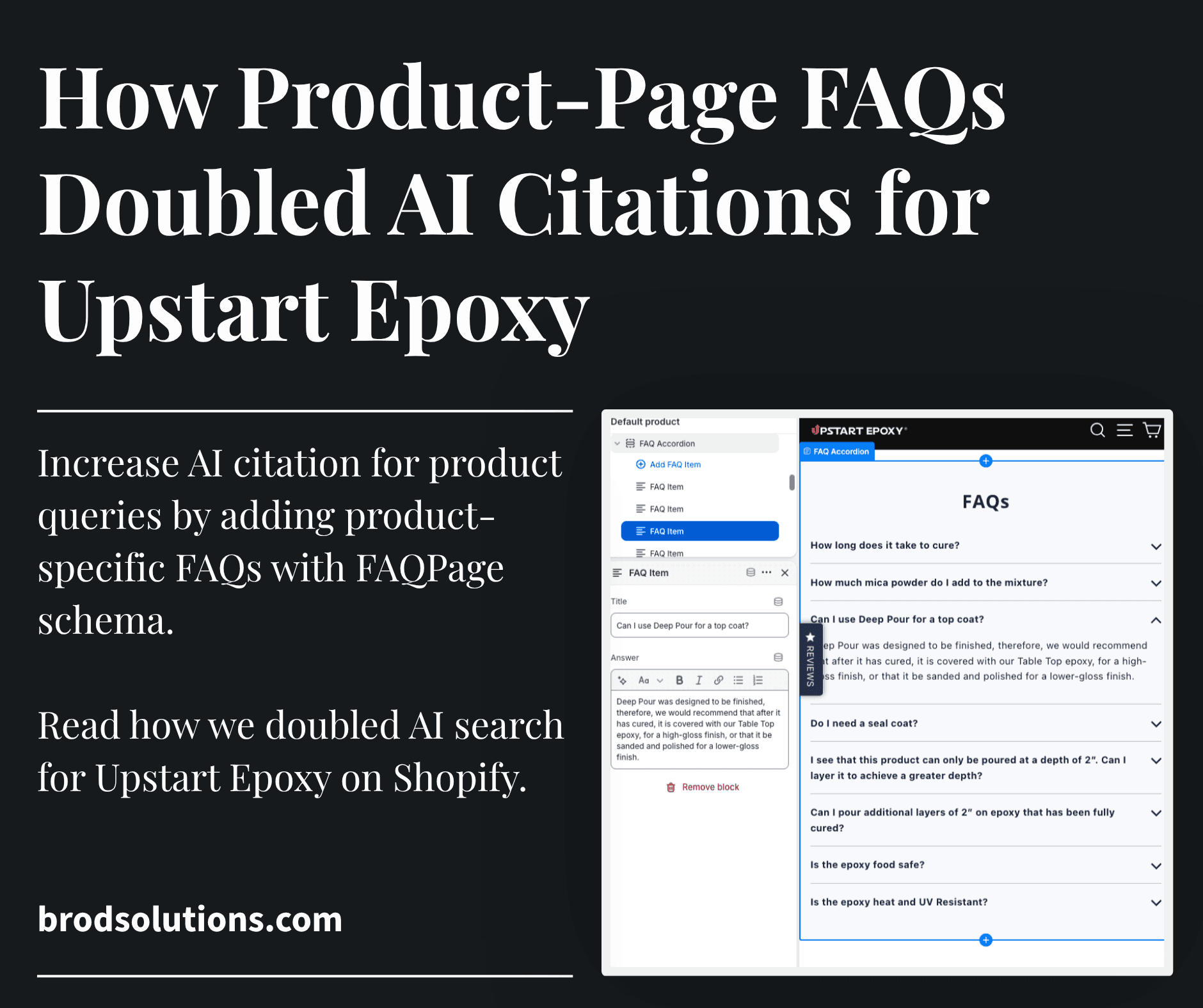
2xAI Overview Citation RateAfter moving product-specific FAQs from a generic page to the Deep Pour Epoxy product page, with structured FAQPage schema, AI citation frequency doubled across targeted product queries.
Why Generic FAQ Pages Fail in AI Search
Google's AI Overviews and other AI search engines operate on a simple principle: surface the most directly relevant passage for the query. "Relevant" means topically close, structurally clear, and semantically specific.
A centralized FAQ page signals relevance to many things simultaneously, which means it signals deep relevance to nothing in particular. An AI model choosing between your generic FAQ page and a competitor's product page that answers the exact question inline will pick the product page almost every time.
The second problem is structural. AI Overviews heavily favor FAQPage schema markup. When your questions and answers are wrapped in proper structured data, Google can parse them as discrete answer units, making them far easier to extract and surface as citations. A wall of paragraph text on a generic page, even if it contains the right information, competes poorly against a properly marked-up product-page FAQ.
The Playbook We Used
Research the actual buyer questions
We pulled search query data for deep pour epoxy terms: pour depth, cure time, yellowing, river table use, temperature, bubbles, pigments. These are the questions buyers ask before they purchase. Not after.
Write direct, specific answers — not marketing copy
Each answer is a self-contained unit of useful information. No filler. No brand language designed to sound impressive. Buyers reading these answers should be able to act on them immediately.
Place the FAQ on the product page itself
Not a linked FAQ page. Not a popup. On the product page, below the main description and specifications, so the page has topical depth and the FAQ inherits the product page's ranking signals.
Implement FAQPage schema
Structured data tells Google exactly what each question and answer is. Without it, your FAQ is just formatted text. With it, it becomes a machine-readable answer set that AI systems can cite with confidence.
The 8 FAQs We Built for the Deep Pour Product Page
Each question was chosen because it appears in pre-purchase search behavior and addresses a real buying objection or technical barrier. Here is exactly what we wrote:
How deep can deep pour epoxy be applied in a single pour?
Upstart Epoxy's deep pour resin can be applied up to 2 inches thick in a single pour. For projects deeper than 2 inches — such as thick river tables or large casting molds — pour in stages, allowing each layer to partially cure (typically 24–48 hours) before adding the next.
How long does deep pour epoxy take to fully cure?
The resin is typically tack-free within 24–48 hours and reaches full cure in 7–14 days depending on pour thickness, ambient temperature, and humidity. The thicker the pour, the longer the cure. Do not put the surface into service until fully cured.
Is Upstart Epoxy UV resistant? Will it yellow over time?
Yes. The formula contains UV inhibitors that resist yellowing even under prolonged light exposure. For surfaces placed outdoors or in direct sunlight long-term, applying a UV-protective polyurethane topcoat is recommended for maximum longevity.
What is the mixing ratio?
Upstart Epoxy deep pour uses a 2:1 ratio by volume — two parts resin (Part A) to one part hardener (Part B). Accurate measurement is critical. Deviating from this ratio will negatively impact the cure and can cause tackiness, cloudiness, or incomplete hardening.
Can this be used for river tables?
Yes, deep pour epoxy is specifically formulated for river table applications. Its low viscosity flows into wood voids cleanly, and its slow exothermic cure minimizes heat buildup in large pours — the primary cause of cracking and yellowing in lesser resins. Seal the wood with a thin coat first to prevent air bubbles from escaping the grain.
How do I prevent air bubbles?
Mix slowly and deliberately to avoid introducing air during blending. After pouring, pass a propane torch or heat gun — held 6–8 inches above the surface — gently over the pour to release trapped bubbles. Work in a room at 70–85°F. Warming the resin bottles in warm water before mixing also reduces viscosity and bubble formation.
Can I add pigments or dyes?
Yes. Compatible with liquid pigments, mica powders, alcohol inks, metallic dyes, and glow-in-the-dark powders. Add colorants to Part A before combining with the hardener and mix thoroughly to avoid uneven color. Test a small batch first when using new colorants.
What temperature should I work in?
The ideal working temperature is 70–85°F (21–29°C). Below 65°F, cure slows significantly and can cause cloudiness. Above 85°F, the exothermic reaction accelerates, which risks cracking or yellowing in large pours. Never pour in humid conditions — moisture interferes with cure chemistry.
The Schema That Makes It Work
Here is a condensed example of the FAQPage schema structure used. This goes in a <script type="application/ld+json"> tag in the page head, or injected via your theme's structured data system.
JSON-LD
{
  "@context":"https://schema.org",
  "@type":"FAQPage",
  "mainEntity": [
    {
      "@type":"Question",
      "name":"How deep can deep pour epoxy be applied in a single pour?",
      "acceptedAnswer": {
        "@type":"Answer",
        "text":"Upstart Epoxy's deep pour resin can be applied
          up to 2 inches thick in a single pour..."
      }
    },
    // ...repeat for each question
  ]
}
What This Means for Your Product Pages
If your store has a generic FAQ page and individual product pages without question-and-answer content, you are leaving AI Overview real estate on the table for every product you sell. AI search systems are now answering pre-purchase questions before users ever reach a product listing. If your product page is not the source of that answer, a competitor's will be.
The stores winning AI citation share in 2026 are not necessarily ranking #1. They are the ones with the most directly relevant, structurally clean, schema-supported answer for the exact query the buyer typed.
The investment is smaller than you think. Eight well-researched questions, specific to the product, with proper schema, placed on the product page. That is the entire intervention. The returns — both in AI visibility and in on-page conversion from buyers who get their objections resolved without leaving the page — compound over time.